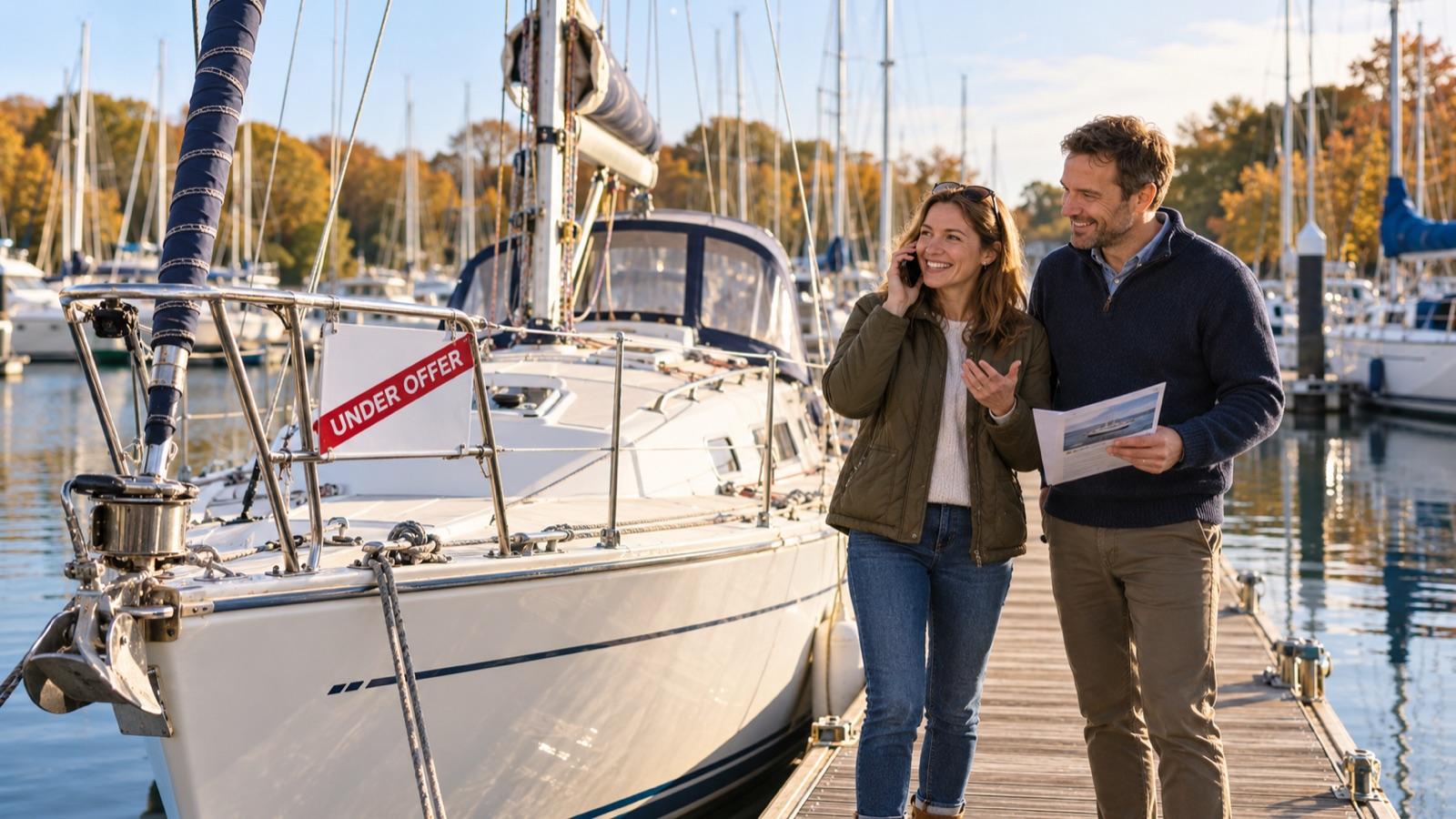
It is a still afternoon in late autumn, and the marina smells faintly of woodsmoke. You have walked a good many towpaths this year. Then there she is: a deep red cabin, brass portholes, and a small board in the window that says For Sale. The broker mentions that she has a current BSS certificate. By the evening you have agreed a price, subject to survey.

Two checks matter from here: the Boat Safety Scheme examination behind that certificate, and your own pre-purchase survey, with her out of the water. Here is what each covers, what the certificate means, and what to arrange, in order.
Two Checks, Two Jobs
The BSS examination looks at a boat's safety installations: gas, fuel, electrics and fire safety. She needs a current certificate for her licence, the permit from the navigation authority (the body that runs the waterway, such as the Canal & River Trust) to keep and cruise her there. A boat under four years old may have an exemption instead, through her builder's declaration.1
The pre-purchase survey looks at the whole boat, for you, before you commit: the steel hull out of the water, the engine, the systems and the cabin.
Each does a job the other cannot. The Scheme says plainly that its examination is not a condition survey, and it strongly advises anyone buying a boat to commission a pre-purchase survey.1 The navigation authority, for its part, asks for the certificate whatever a survey says.
What a BSS Certificate Means
The Boat Safety Scheme (BSS) sets minimum safety requirements for boats on most of the UK's inland waterways, with the backing of the Canal & River Trust, the Environment Agency and other navigation authorities. Its examination asks whether a boat meets those requirements "on the day it was carried out".2 There are three possible answers. Yes brings a certificate. Yes, but some advice checks did not pass brings a certificate too: advice checks are best safety practice, not needed for the certificate on a private boat (one that is not hired out or run as a business), and the Scheme notes they may matter to an insurer. No means work is needed first. A certificate lasts up to four years.
So the certificate tells you her safety installations met the requirements on the day of her last examination. The Scheme says the examination does not cover the condition of the hull or deck, the fittings through the hull, or her general mechanical condition.2 And on the Trust's waters a boat must meet the standards at all times,1 so from completion that becomes yours to keep up. Our post on the BSS examination and the pre-purchase survey goes further into what a certificate leaves out.
Three things to do with it:
- Ask for the examination report with the certificate number and expiry date, and read any comments on advice checks. A warning notice among the papers means an examiner found a significant and immediate risk, so ask what was done about it.2
- Check the expiry date. If it runs out soon, then before you sign the sale agreement, agree with the seller who arranges the next examination. If she has no certificate or exemption, find out what work she needs first: she cannot be licensed on the Trust's waters until she has one.1
- If the papers have gone astray, the certificate is recorded on the Scheme's database, which the navigation authority can check.2
What the BSS checks
The full checklist is published, as the Scheme's Examination Checking Procedures.3 For a private boat it covers:
- Fuel: the tanks, pipes, filters and shut-off valves.
- Electrics: batteries held secure, cables, fuses, and the isolator switches that cut the batteries off.
- Fire: extinguishers, a fire blanket where there is a cooker, and a way out of the cabin.
- Carbon monoxide alarms.
- Gas: the cylinder locker (where the gas bottles live), the pipework, the shut-off valves and a test that the system holds gas tight.
- Appliances: the cooker, heaters and stove, their flues, and the boat's ventilation.
- Pollution: a tray or sealed space to catch oil leaking from the engine.
Survey Day: the Hull out of the Water
A narrowboat lives afloat, so for the survey she usually goes into a dry dock (a chamber drained to leave her standing on blocks), up a slipway (a ramp she is winched up), or out by crane. The broker, or the seller in a private sale, usually arranges this with the yard, along with the trip there. The yard's charge comes on top of the survey fee,4 so agree who pays. If you are asked to take her yourself, check first that the seller's insurance covers you at the tiller. In winter, closures on the canal can lengthen the trip: buying a boat in winter covers that.
Surveyors who work on the canals often offer a hull survey, of the hull alone, and a full survey of the whole boat.4 A hull survey on its own often serves an insurer. For a purchase, the full survey is the usual choice. Her licence needs insurance, so ask an insurer early what survey they want for a boat of her age; the one survey can often serve both.

With her out, the hull is washed off and your surveyor looks along it. They take thickness readings with an ultrasonic gauge, which sends a pulse of sound through the steel and times its echoes. Some gauges can read through a thin, sound coating, though thick bitumen blacking (the protective paint on a steel hull) passes sound poorly, so the surveyor may clean small spots back to bare steel.5 The readings are taken at points across the bottom (the baseplate), the sides, the band at the waterline and both ends.
Your surveyor reads them together: where the steel is thinner, by how much, and over how wide an area. They also look at the welds, at earlier repairs such as overplating (new steel welded over a thin area), and at the rudder, propeller and weed hatch (the hatch above the propeller, for clearing it). Aboard, they look at the engine, the gas, the stove and its flue, and the electrics, as far as these can be seen and run on the day. A marine engineer can look deeper into the engine if you ask for one.4 Linings, fixed floors and ballast are not lifted, and the patches she rests on cannot be read, so the report says what could not be seen. Our posts on steel hull readings and recording overplating go into the detail, and are written for surveyors.
A survey does not include a BSS examination unless one is arranged. Some surveyors are also BSS examiners, and can do both on one visit if asked.4
What to Arrange, in Order
- Your offer, subject to survey. You usually sign a sale agreement and pay a deposit. Read its survey and deposit terms before you sign, and ask the broker how many days you will have to reply after the survey. Offer agreed: from survey to keys walks through the steps from here.
- Her mooring. A mooring agreement is not normally handed on with the boat.4 If she comes with one, ask the broker or the mooring provider now whether it can pass to you, and whether you may live aboard there if you plan to. Without a home mooring, the Trust can license her for continuous cruising: a genuine journey around a fair range of the network, staying no more than 14 days in one place, or less where signs say so. If work or school will keep you in one area, the Trust asks you to think about how you will still cruise genuinely, so settle this before you buy.6
- The papers. The BSS certificate and examination report, any earlier surveys, and receipts for blacking and hull work: steel boats usually come out for blacking every two to three years.5 Buying privately, ask to see the seller's own bill of sale (the document that passed her to them), since the Trust's licence records do not show who owns a boat.6
- Your surveyor. Find a narrowboat surveyor near the boat and ring two or three. Ask each for a quote, what it covers, and when the report will be ready. Our buying a boat page has all seven questions worth asking, and how to choose a marine surveyor goes further. Whether you attend on the day is a question for your surveyor.
- The dock and survey day. With the seller's agreement, the broker (or the seller, buying privately) books the dock and has her ready: keys, batteries charged and lockers cleared.
- The report, and your reply. Most reports on a second-hand boat list some findings. Many surveyors grade them by urgency, often as Category A, B and C, with A the most urgent, and your surveyor will explain which matter. What to expect from a survey report shows how a report is laid out, and our sample narrowboat report shows a full one. Depending on your agreement, you can then accept her, ask the seller to put findings right or lower the price, or withdraw. If the survey shows her to be materially unsatisfactory, the deposit is normally refunded.4
- Before completion (the day she becomes yours): insurance ready from the day you complete, and your own licence. On the Trust's waters a standard licence does not pass to a new owner. You buy one with her BSS certificate number and your insurance details, and tell the Trust that you have bought her.6
Other navigation authorities set their own terms, so check with the one for her waters. Then put the kettle on. She's yours.
Our buying a boat page has the seven questions and the "Before survey day" list. When you are ready, find a narrowboat surveyor near the boat. A free account keeps your shortlist and a private note on each surveyor, on iPhone, iPad and Android.
Footnotes
-
Canal & River Trust, Boat Safety Scheme (last edited 25 August 2026): "Before you buy a boat licence, you'll need a valid Boat Safety Scheme (BSS) certificate or exemption", and "your boat must comply with the BSS standards at all times when on our waters." Boat Safety Scheme, Q and A on BSS Examinations: most navigation authorities accept a complete new boat's Declaration of Conformity in place of a certificate for its first four years, and a navigation authority still asks for BSS certification after a full survey. BSS Certification: what it is and what it is not: "A BSS examination is not a full condition survey", and "Prospective boat purchasers are strongly advised to … commission a pre-purchase survey". ↩ ↩2 ↩3 ↩4
-
Boat Safety Scheme, BSS Certification: what it is and what it is not: the question the examination answers, its three results, advice checks as "best-safety practice" that "may be material to the vessel's insurance", warning notices for "a significant and immediate risk", and "it does not cover the condition of the hull or deck, the integrity of through-hull fittings or the stability of the boat and it isn't the same as having your boat serviced and doesn't check its general mechanical condition." Preparing for examination: a certificate lasts "48 months maximum". BSS Certification Reports explained: reports are held on the BSS database, which most navigation authorities can access. Notes on the BSS Examination: owners are asked to keep the Examination Reports with the certification report and "pass these on with all documents if you sell the boat". ↩ ↩2 ↩3 ↩4
-
Boat Safety Scheme, Core BSS Examination Checking Procedures, Edition 5 (July 2023). Parts 2 to 9 hold the checks for a private boat: fuel systems, electrical systems, electric propulsion, outboard and portable fuel systems, fire extinguishing and escape with carbon monoxide alarms, gas, appliances with their flues and ventilation, and pollution prevention. A few are advice checks for a private boat, among them the means of escape and the shore-power (mains) checks. The Scheme's 10 most common non-compliances gives a plain-English taste of the checks. ↩
-
Canal & River Trust, Buying a second hand boat (last edited 29 January 2025): surveyors' hull and full surveys; "the charge to lift the boat out of the water for a hull or full survey will be extra and payable to the boat yard"; an insurer may ask for a hull survey on an older boat; "You can also request an engine survey to be carried out by a qualified engineer"; "Unless specifically asked, the surveyor will not automatically carry out a BSS examination as part of the survey"; "It's not normal for mooring agreements to be assignable to a new owner of the boat"; and a deposit "typically around 10% 'subject to survey'", with "If your survey suggests that the boat is materially unsatisfactory, the deposit will normally be refunded." Your own sale agreement governs; ask your broker or a solicitor about its terms. ↩ ↩2 ↩3 ↩4 ↩5 ↩6
-
Cygnus Instruments, Multiple-Echo Technique: its gauges can measure through coatings, but "soft coatings like rubber or bitumen don't transmit ultrasound very successfully", coatings must not have "de-laminated/de-bonded from the metal surface", and on heavily corroded steel "measurements may not be possible". Canal & River Trust, Hull maintenance (last edited 22 January 2025): "Steel boats are usually removed from the water for 'blacking' every two to three years", with "bitumen-based paints or Two Pack Epoxy Paint systems" used on steel hulls. ↩ ↩2
-
Canal & River Trust, FAQs on boat licensing, buying and selling (last edited 26 August 2026): a licence needs a valid BSS certificate and an insurance cover note; "Standard six and 12-month Canal & River licences are not transferrable"; a buyer must tell the Trust they have taken on the boat; and "The Canal & River Trust are not the authority who retains ownership details". Continuous cruising: your questions answered (last edited 20 October 2025): "genuinely cruising a fair range of our network", "not staying longer than 14 days on regular (unsigned) stretches of the canal or longer than what the short-stay mooring signs tell you", and, for anyone who must regularly stay in one place or area for work or school, "you need to consider how you'll continue to genuinely cruise throughout the whole licence period." The Environment Agency, the Broads Authority, Scottish Canals and the other navigation authorities set their own terms. ↩ ↩2 ↩3