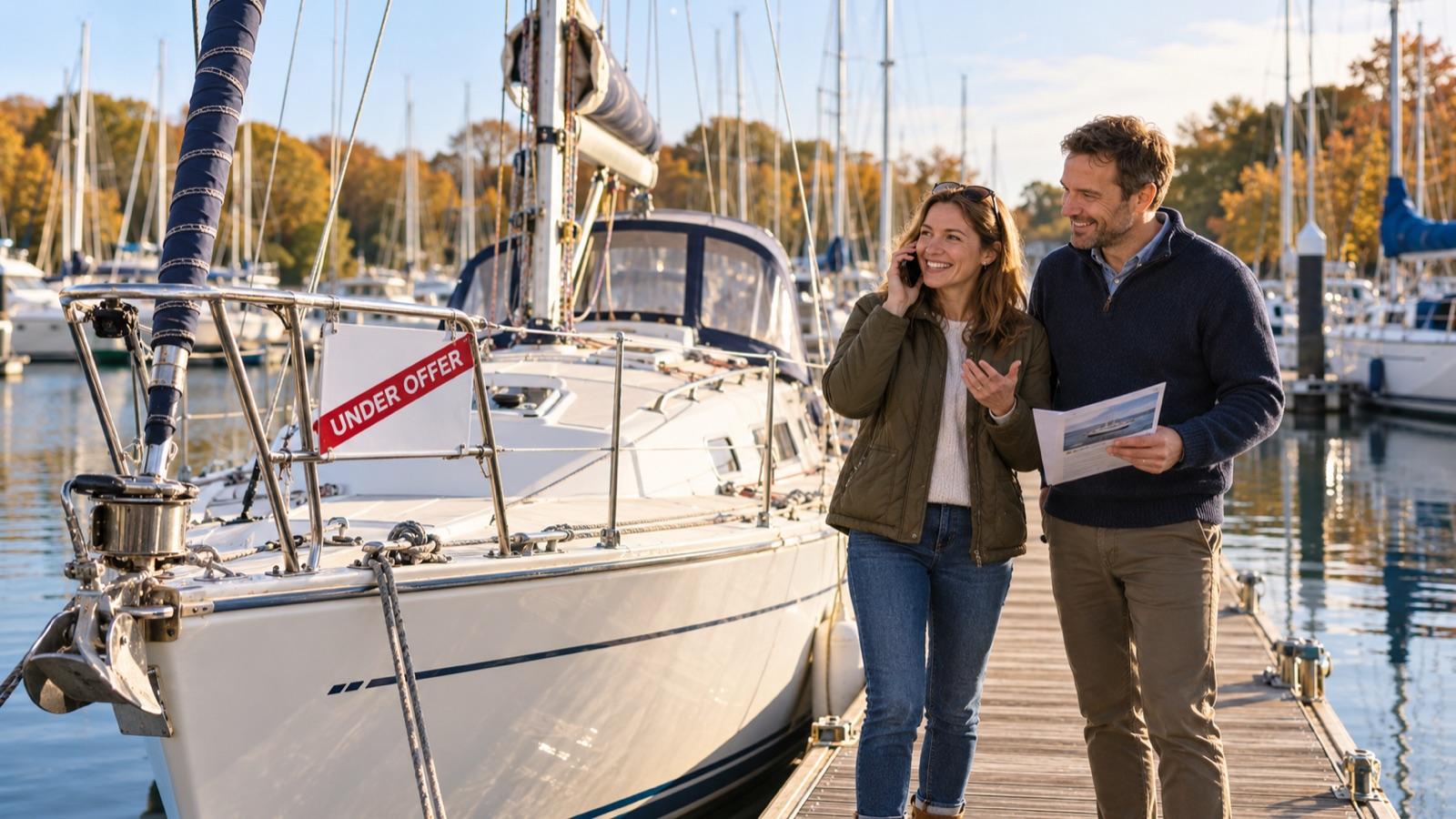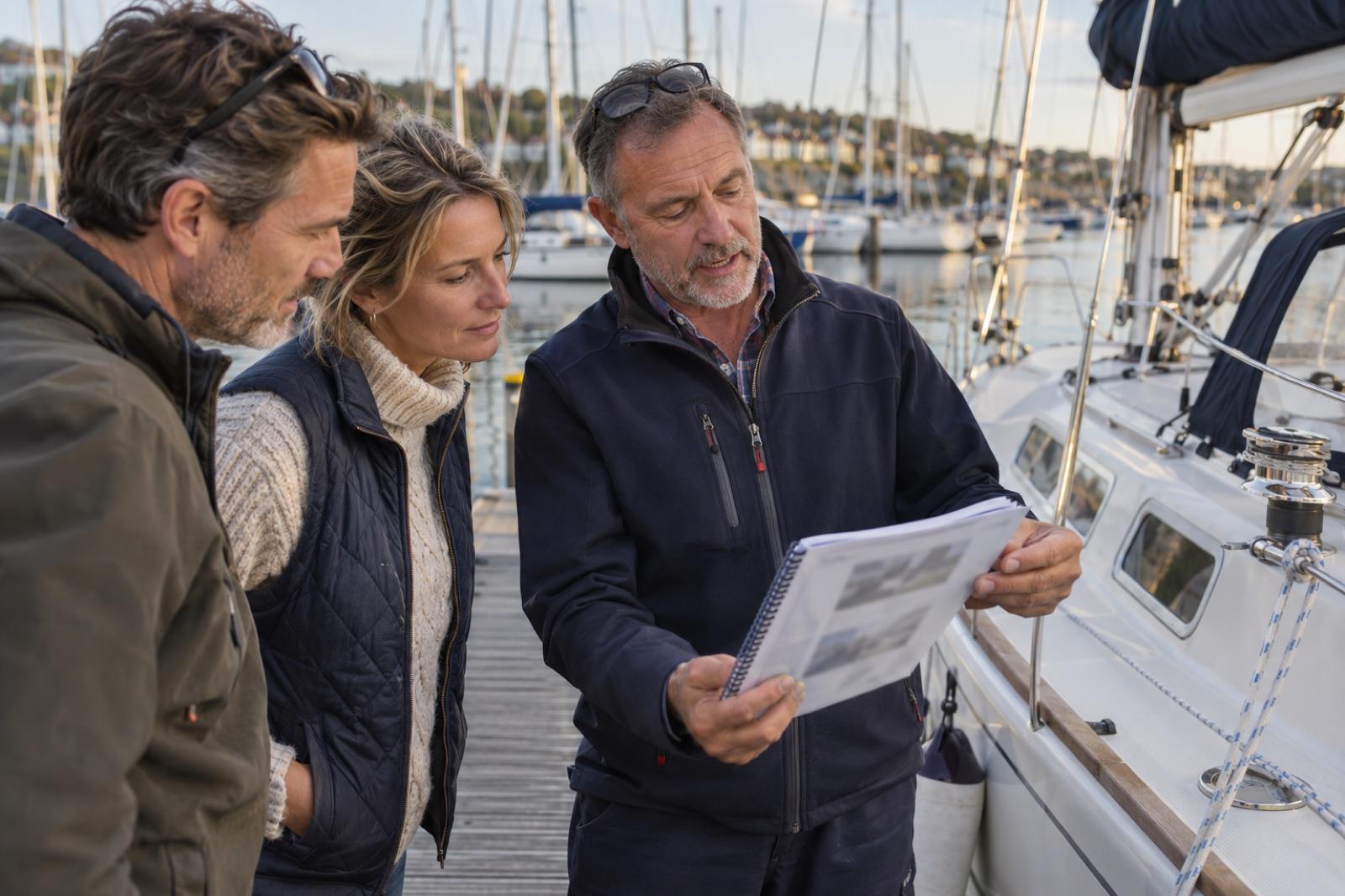
It is a bright, frosty morning in November. The yard is quiet. Boats stand ashore in rows for the winter, many under covers, and your breath hangs in the air as you walk between them with the particulars (the broker's description of the boat) in your hand. Then you see her. By Monday the broker has rung: your offer is agreed, subject to survey.

Is It Better to Buy a Boat in Winter?
It can suit you well. Price and choice are a conversation for you and the broker. For the survey, winter brings some real advantages and asks for a little more planning. Here is what winter gives you, what takes more planning, and what to agree before survey day, for a yacht, a motor boat or a narrowboat.
What Winter Gives You
She is often ashore already. Most pre-purchase surveys look at the hull out of the water. A boat laid up for the winter (put to bed until spring) usually stands on the hard, the yard's area for boats ashore, so no lift-out needs booking for the survey. Any work below the waterline that the survey recommends can be done before she goes back in. If she winters afloat in a marina, the survey runs much as it would in summer: a lift-out is booked, and her engine is easier to try.
You see how she is kept. Water drained, batteries kept charged, a cover with air beneath it: a boat's lay-up shows how she has been looked after.
The mast may be down. Some yachts winter with the mast lifted off and laid on trestles, and the rig (the mast and its wires) can then be looked at closely at ground level.1 How much of the rig a survey covers varies, so ask.
There is time to plan. Marine trades tend to be at their busiest from March to midsummer.1 Work the survey finds in winter can often be booked before the season starts.
What Takes More Planning
The engine. A boat laid up for the winter usually has her engine winterised, or prepared for the frost. Most inboard engines hold coolant, as a car does, cooled in turn by seawater or river water that is drawn in and sent out with the exhaust (the raw-water side). Over the winter that side is drained or filled with antifreeze. With the boat ashore, it is harder to see the engine run.1 It can still be run, with the seller's agreement and the yard's, by the yard or a marine engineer, who sets up a water supply to the cooling intake. That shows it starting and running. How it copes with real work, driving the boat through the water, is for a sea trial. Running it flushes the antifreeze out of the raw-water side, so it is winterised again the same day. For a closer look, a separate inspection by a marine engineer can be worth having.2
The sea trial. A sea trial (a short trip under way, to see the engine, steering and equipment working) needs her afloat. For a boat ashore that means putting her back in the water, lifting her out again afterwards, and a day of decent weather. A trial is often arranged separately from the survey,2 so ask your surveyor whether it is included.
Drained systems and stored kit. Fresh water, heating and the toilet are usually drained for the winter, and may not be filled and tested on the day. Sails, cushions and other kit often go into store.1 Ask for anything listed in the particulars to be at the boat on survey day, so the surveyor can see it.
Moisture readings. On a fibreglass hull the surveyor takes moisture readings, which look for water in the laminate (the layers of glass fibre and resin the hull is made of), which can be an early sign of trouble such as blistering. They depend on how long she has been out of the water and on the day.3 One winter detail is worth knowing: a moisture meter cannot see water that has frozen. When the hull itself is below freezing, a meter can show wet laminate as dry. A heavy dew or a thaw does the opposite, and water on the surface makes readings high. A surveyor working in winter allows for this, and readings may wait until the hull has thawed and dried, later in the day or on a milder one. If the readings matter to your decision, ask your surveyor what the day's conditions meant for them.
Shorter days, and the weather. The light goes early, and frost, rain or snow on deck can slow a survey or move it to another day. The winter cover will need to come off. The pads on her stands and the blocks under her keel hide a few patches of hull. The yard can move the pads one at a time, if it is asked in advance. Seeing under the keel blocks means lifting her in the slings of the yard's hoist (the wheeled frame that lifts boats out), so ask your surveyor whether they need it.
These are the ordinary limits of a winter survey. The report will say what could not be seen or tested, so you know what is left to check. What to expect from a survey report walks through a report section by section.
Agree These Before Survey Day
Settle these through the broker, in writing, ideally before you sign the sale agreement, or as soon as you can if you already have. Buying privately, agree them with the seller.
- The survey date. Many agreements set a date, or a number of days, for the survey. Ask the broker what happens if it passes with no survey done. If frost, ice or a closed canal lock could push survey day back, ask the broker to agree a later date with the seller, in writing, before the first one passes.
- The engine. Who makes it ready to run (usually the yard or a marine engineer, with the yard's agreement), and who winterises it again the same day.
- The sea trial, and anything else that waits. In many agreements, silence counts as accepting the boat once the days allowed for your reply have passed,2 so ask the broker when those days start. Anything checked after completion is yours to put right. If a sea trial or a second set of readings matters to your decision, agree when it happens, how it fits the dates and who pays for the launch and the lift. Costs you ask for are usually yours.
- Access on the day. The cover off or ready to come off, and who puts it back; keys aboard, batteries charged, lockers cleared, and any stored kit back aboard. Our buying a boat page has the full "Before survey day" list.
- Your reply, and putting her back. After the report you can usually accept her, ask the seller to put findings right or lower the price, or withdraw; offer agreed: from survey to keys explains each. Ask the broker whether your agreement lets you withdraw for any reason, or only for defects you had not been told about. If the survey finds the boat materially unsatisfactory, the deposit is normally refunded;2 ask what may be deducted, and who pays to put the boat back as you found her. In winter that can mean a lift back out after a trial, and winterising the engine again.
When you ring surveyors, two of the seven questions on our buying page do most of the work in winter: "Out of the water, afloat, or both?" and "Is a sea trial included?" How to choose a marine surveyor goes into the rest. Whether you attend on the day is a question for your surveyor.
If She's a Narrowboat

Most narrowboats winter afloat, so the survey usually takes her into a dry dock (a chamber drained to leave the boat on blocks) or up a slipway (a ramp she is hauled up). Winter changes a few things inland.
- The journey to the dock. Each winter the Canal & River Trust closes some locks and stretches for maintenance, and it advises against cruising through thick ice.4 Check the closures (stoppages) on the route with the Trust, or the navigation authority for her waterway, before the dock is booked, and leave room in the survey date. The seller or broker often arranges the move. If you are asked to take her yourself, check that the seller's insurance covers you while you steer, and if you would rather not handle her in winter, ask them to move her.
- The engine. Many narrowboat engines are keel-cooled: their coolant, antifreeze and all, runs through a tank against the hull, and no canal water comes in. Running one leaves its winterising in place. Afloat, the engine can usually be run at the mooring; ask whether a short trip is part of the survey.
- Living aboard. If she is lived aboard, her stove and heating are likely in use, and winter shows where condensation gathers.
- The BSS certificate. A Boat Safety Scheme (BSS) examination checks an inland boat's gas, fuel and electrical installations, and you need a current certificate for her licence (the permit to use her on the waterways, from the navigation authority). Check its expiry date, and if it runs out soon, agree with the seller who arranges the next examination. BSS examination or pre-purchase survey? explains how the two sit side by side.
Completing in Winter
Ask the broker who carries the risk in the boat until completion (the day she becomes yours), and how your agreement treats damage during the survey or a trial. Arrange your insurance to start at completion. Your insurer may ask to see the report, so send it early. If she is to stay ashore until spring, ask the yard whether she can stay on and on what terms, ask the broker to confirm the seller's yard fees are paid up to completion, and tell your insurer she is laid up ashore. If her engine was run for the survey or a trial, check it was winterised again. Laying up for winter walks through the rest of the jobs.
Then she's yours.
Our buying a boat page walks the road from offer to keys, with the seven questions and the "Before survey day" list. When you are ready, find a yacht surveyor, a boat surveyor for a motor boat or a narrowboat surveyor near the boat, and ask each about winter when you call. A free account keeps your shortlist and a private note on each surveyor, on iPhone, iPad and Android.
Footnotes
-
Practical Boat Owner, Crucial checks when viewing a boat (Rupert Holmes, November 2019): "A boat out of the water provides easy access, but it will be difficult to check how the engine runs"; marine tradespeople "tend to be flat out from March to mid-summer", so buying early "can give a chance to beat the queues". On running an engine ashore with a water feed, the surveyor in Practical Boat Owner's Project Boat survey (Ali Wood, August 2021). On cushions, canopies and sails taken to a dry store, and a mast taken down allowing a thorough rig inspection, Navigators & General's laying-up advice in Motor Boat & Yachting, Laying-up advice from N&G (October 2007). ↩ ↩2 ↩3 ↩4
-
Sale agreements differ, and your own governs. Practical Boat Owner, Buying a boat: the essential guide (Rupert Holmes, November 2023): an offer may be subject to survey "and possibly sea trial, rig inspection and mechanical survey", with around 14 days usually allowed; "Sea trials are not normally part of a regular survey"; a separate mechanical survey may be worth commissioning; and the buyer budgets for lifting a boat ashore. On silence counting as acceptance, a maritime lawyer writing in Marlin notes that agreements deeming the buyer to have accepted the boat unless they reject it in writing are "more common in Europe and other jurisdictions", while most US agreements work the other way: Sale agreements for fishing boats (Raleigh P. Watson, updated March 2017). Canal & River Trust, Buying a second hand boat (last edited 29 January 2025): a deposit of typically around 10% "subject to survey", and "If your survey suggests that the boat is materially unsatisfactory, the deposit will normally be refunded." Royal Yachting Association, Boat buying made easy: check that your agreement lets you withdraw after the survey or sea trial. Ask your broker or a solicitor about your own agreement's terms. The joint BRBA and ABYA (Association of Brokers and Yacht Agents) Sale and Purchase Agreement is available to members only, so it is not quoted here. ↩ ↩2 ↩3 ↩4
-
Practical Sailor, Moisture meters: can you trust them? (Darrell Nicholson; first published August 2000, updated February 2026): "not to trust any moisture meter readings taken when the laminate is below 32 F" (0°C), and "If the boat has just been hauled, allow some time for surface moisture to evaporate." Steve D'Antonio, Moisture testing: dryer is better (BoatTEST, March 2022): a meter used in sub-freezing conditions is "virtually guaranteed to show anything over which it's passed as dry"; "the slightest degree of surface moisture" can affect readings; and a hull bottom should dry "for at least 24 hours depending on climate and temperature". On fibreglass a meter reads on a comparative scale of its own (0 to 100 on the Tramex Skipper Plus), not as a true percentage of moisture, and the maker lists early detection "before blistering appears" among its uses: Tramex Skipper Plus datasheet. ↩
-
Canal & River Trust, Winter works programme: "Each winter, when waterway usage is typically reduced, we undertake a programme of essential maintenance and repair works", for which "it is often necessary to fully close sections of the waterway". The Trust's Eight tips when winter cruising (last edited 8 September 2023): "Don't cruise if the ice is thick", and "Check for any planned stoppages before your journey." Other navigation authorities publish their own notices. ↩