About a hundred yards separates two very different views of a boat at Mayflower Park. On the hardstanding, a new widebeam sits on its blocks with a For Sale board on the roof. The plate, the weld seams, the anodes and the bow-thruster tunnel are all at eye height, and anybody walking past can put a hand on them. Out in the show marina, more than 250 boats lie afloat with exactly that half of themselves under water.

This was our first Southampton, and the contrast between those two views is the reason a surveyor should go. The marina is the best place in the country to walk a season's worth of new hull forms, helm layouts and engine installations in a morning. The hardstanding is where the underwater half is on display. Between them they describe the fleet that will be arriving on the hard for survey work over the next decade.
What the coverage settled on
The 57th edition ran from 18 to 27 September 2026 at Mayflower Park, with more than 500 watercraft across the site, over 250 of them afloat in the show marina, and organisers expecting the usual attendance of more than 90,000 over the ten days. Around 25 world, UK and show boat debuts were announced, alongside more than 20 launches of new marine technology and equipment.1
The previews converged on much the same list. Cockwells took the headline with the world premiere of the Duchy 45, a 14.74m semi-displacement GRP launch by Andrew Wolstenholme, running twin Volvo Penta IPS 600 pod drives to a quoted 25-knot cruise.2 Nord Star gave the 49+ SCY its world debut on an optional triple Volvo Penta D6-480 sterndrive installation, Key Yachting the Nautitech 41 Type S catamaran and Multihull Solutions the Dragonfly 40 Carbon trimaran. UK debuts ran through the Hallberg-Rassy 370, Najad 451 AC and J/40 under sail, and the Fairline Targa 58 GTO, Sirena 48, Windy SR40, Viknes S35 Panorama and Highfield ADV9 under power. The Sunseeker 90 Ocean, at 27.1m, was the largest boat on the water.3
That is a buyer's list, and it reads as one. Recast as a surveyor's list, the same fleet says something specific about the next ten years of inspection work.
Seawork shows the technology, Southampton shows the market
Three months earlier, Seawork filled the same park with crew transfer vessels, workboats and operators buying kit from other businesses. Southampton in September is the other half of that trade, aimed at owners, families and first-time buyers, with almost everything on the water small craft. The two shows answer different questions. Seawork shows which technologies are entering the sector and being proven in hard commercial use. Southampton shows which of them the private market is buying, at what size of boat and in what volume. A hybrid drivetrain at Seawork is a signal. A pod drive in a 45-foot production launch at Southampton is a fleet.
A new boat reaches a surveyor sooner than the brokerage calendar suggests. The first job can be a pre-delivery inspection, a warranty dispute or a damage claim, any of which lands in the first season afloat. Pre-purchase work follows at the first resale. The insurance condition survey comes later, and there is no industry-wide trigger for it: each insurer sets its own in the policy wording, and age is the usual basis. One marine insurance view puts it at over twenty years for a production boat and at ten to fifteen for a wooden one.4 A change of insurer, a higher sum insured or a first-time placement can bring it forward at any age, and the policy wording is what defines both the scope wanted and how recent the survey has to be. All of them read the same systems, so the fleet on the pontoons this week is the fleet on the hard across the decade that follows.
Pods and stern drives, now at 45 feet
The Duchy 45 is a useful marker. A classically styled Cornish launch with a varnished transom and a semi-displacement hull, running twin pod drives as standard, shows where mid-size production power has landed.

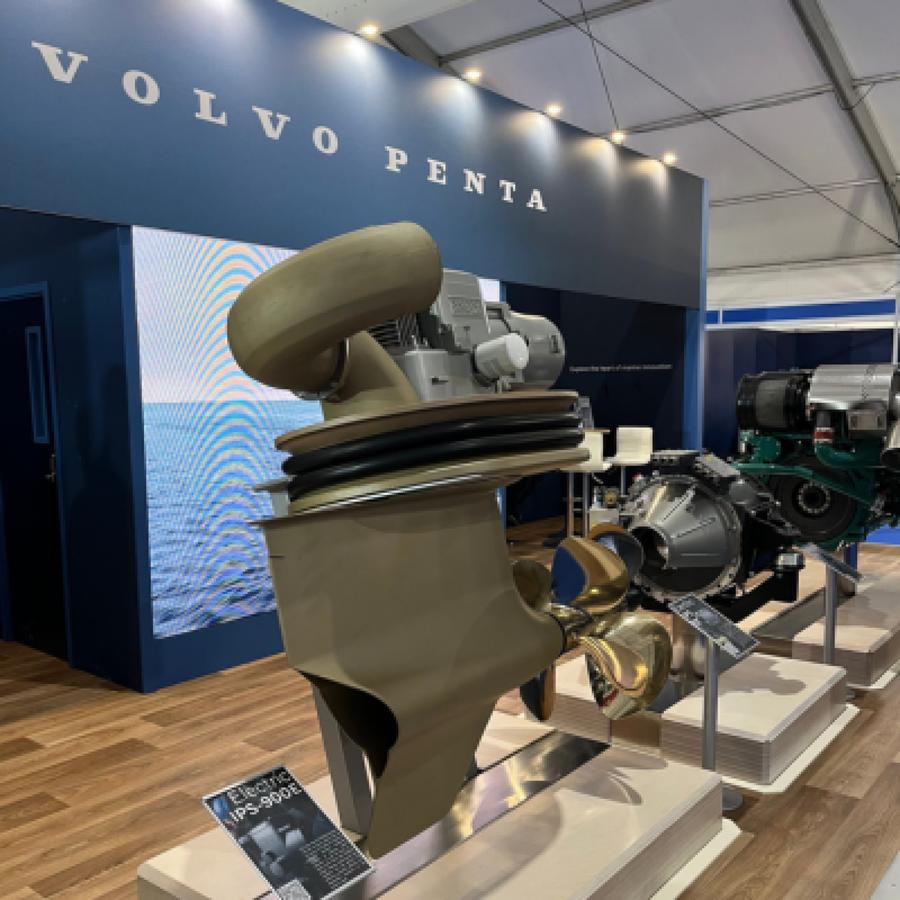
A pod installation moves several inspection items out of the engine bay and through the bottom of the boat. The drive is a sealed unit passing through a moulded aperture, with its own seals and bellows, its own gear oil and its own anode set. Drive-oil condition and the seal record carry real weight here, because a seal failure puts water into a gearbox.
One detail is worth knowing before a pod boat arrives on the hard. Volvo Penta IPS drives are designed so the underwater unit shears away in a serious grounding, protecting the hull structure, and the reported cases are consistent with that.5 It is a design intent tested under particular conditions, so a grounding on an IPS boat can present with an unmarked hull and a dry bilge.
That makes the drive's replacement history a line of enquiry. Pods also come off for gearbox and seal failure, corrosion, rope strikes, warranty work and repower, so a replacement is a question and not a finding. Where one has no scheduled overhaul behind it, record the drive serials and dates against the build date, ask for the service and claim records, and inspect the structure the deceleration passed through: the mounting flange and its seals, the laminate around the aperture, the stringers and engine bearers, the mounts and the shaft alignment. That enquiry belongs in the hull and structure section, with the propulsion record cross-referenced to it.
The Nord Star 49+ SCY makes the same point in a different shape. A triple stern-drive installation means three transom apertures, three sets of bellows and three gimbal bearings, all carried by one transom, and the D6-480 in sterndrive form is a DPI drive, which steers by wire as standard, so there are three electric steering actuators and the network that ties them to a single joystick.6 That transom becomes one of the most consequential pieces of laminate on the boat. With no steering cable to fall back on, two more items earn a place on the list: the engine-space fixed fire suppression, with its service date and its discharge interlocks, and the builder's emergency steering provision, found and demonstrated.
The outboard transom
The outboard stands were among the busiest parts of the site, and the engines on display sat at the large end of the range. Suzuki showed the DF300B and DF350A, both from the 4.4-litre V6 family that drives contra-rotating dual propellers on concentric shafts.7 Mercury had Verados on the quayside, and Honda listed its full range from 2.3hp up to 350hp among the show's new-product launches.1

Twin and triple outboard rigs are now ordinary on boats that would once have carried a single sterndrive, and they change the shape of an inspection. The most valuable removable component on the vessel is bolted to the outside of the transom and comes off with hand tools, so serial numbers belong in the record as a matter of course. Behind them, the transom laminate and its backing arrangement carry a load older hulls never saw, and every rigging tube is a penetration whose seal leads straight into the transom core. Each engine also wants its own start battery and its own overcurrent protection, which is where a three-engine boat quietly becomes an electrical survey as much as a propulsion one. The battery and shore power checks apply with full force here.
The engine bay got quieter and harder to read
The Yanmar stand carried a 4LV250 and a 4JH110 open on their frames, which between them span a good part of the small-craft power range.

Both are common-rail engines. The 4LV250 is a 2.755-litre four-cylinder rated at 250mhp with a Denso common-rail system, and the 4JH110 is a 2.0-litre four rated at 110mhp on a Bosch system. Both are certified to RCD 2, and both are approved to run on HVO.8 Three practical consequences follow for anybody writing a report on one.
Common rail means an engine control unit, and the ECU holds a running hours count and a fault history. Reading it takes licensed diagnostic software and an interface cable, which is workshop equipment rather than survey kit, and interrogating an engine's fault memory on a vessel the surveyor does not own sits outside the ordinary scope of a pre-purchase survey. The route to that data is a dealer engine report commissioned alongside.
A simpler check is available on the day. NMEA 2000 broadcasts total engine hours as a field of PGN 127489, so where a gateway is fitted, a bus analyser reads the engine's own figure off the network and puts it beside the number on the display.9 Which makes the next fact worth establishing first: on both these Yanmars the NMEA 2000 engine-monitoring system sits under optional accessories rather than in the standard package.8 Two apparently identical boats off the same line can differ on whether engine data reaches the network at all, and recording which one is in front of the surveyor gives the report a fact the next reader can rely on.
HVO approval means the fuel in the tank is worth recording. Hydrotreated vegetable oil is a drop-in diesel substitute, and an engine that predates the approvals may be running on it anyway. Noting the fuel type alongside the filter and water-separator condition gives the next surveyor a baseline.
Hulls: infused, cored and carbon
The sail debuts were the more interesting read on construction. The Najad 451 AC is built in vacuum-infused sandwich, and the Dragonfly 40 Carbon uses pre-preg carbon for its floats and wings, cutting roughly a fifth of the weight and folding to a 4m beam on its Swing Wing mechanism.3
Cored and infused laminates reward a method built around them. A capacitance moisture meter reads the near surface of a laminate and is calibrated on solid GRP, so on a cored hull it describes the outer skin and says nothing certain about the core behind it. The ingress routes worth working along are the skin fittings and seacock spigots, the transducer and log apertures, the keel and keel-bolt penetrations, the engine bearer fastenings and the stern gear, with the pod aperture and the outboard rigging tubes joining that list on this fleet.
Percussion keeps its value on sandwich panels, carbon included, because a skin-to-core disbond changes the tone plainly. It goes quiet on thick monolithic laminate, where the stiffness of the material masks an interlaminar defect, and on a boat like the Dragonfly that is where the load concentrates: chainplate landings, ring frames, and the beam and hinge landings. Impact damage in carbon can leave almost no visible mark, so the inspection leans on load paths, fastening areas and a documented history of what the boat has hit. A folding multihull adds a hinge mechanism that is a structural member in its own right.
The Hallberg-Rassy 370 carries the detail that most repays a second look. The builder's standard specification, issued 24 November 2025, describes a keel with a lead bulb on an epoxy-treated cast iron blade, bolted with many stainless steel bolts.10 That arrangement puts the interesting questions in three places. The bulb-to-fin fairing line is where cracking, weeping and rust staining show first. The coating is what keeps water off the iron, and an epoxy system on cast iron gives way to impact, abrasion and chipping long before the iron itself is in trouble, so coating breakdown is the finding to look for rather than the corrosion that follows it. And the joint puts stainless bolts into a wet, oxygen-starved cast iron landing, the classic setting for the crevice corrosion that makes keel bolts one of the hardest calls in the trade, and the subject of our piece on documenting keel integrity. The internal sump, the staining at the bolt heads and the torque record are where that one gets answered. Hallberg-Rassy has more than one specification document in circulation for the 370 and they differ on how the blade is protected, so the specification issued for the individual hull is what governs.
The same boat is offered with bow and stern thrusters, which the builder describes as new for this size of yacht.10 Each is a moulded tunnel through the hull, an anode inside it, and a heavy DC run to the bow with a dedicated battery usually at the forward end.
The equipment stands made the same point: among the technology debuts were an all-electric gyro stabiliser, a marine energy-management system and updated climate units, each of them a subsystem that draws real current and has to be found and recorded on a survey ten years from now.1
Lithium earns its own line. LiFePO₄ is now routine on boats of this generation, arriving as a factory option or as a retrofit in the first few seasons, and the recurring findings are consistent: a drop-in pack behind a standard alternator with no battery-to-battery charger, no protection for that alternator against a load dump when the battery management system disconnects, no low-temperature charge cut-out, and an installation arranged outside any recognised standard. ISO 23625:2025 covers selection and installation on small craft and now reaches any system above 500 Wh.11 It is recognised good practice rather than a legal requirement, so the finding to write is the installation arrangement and the risk it creates, with the standard named as what it falls short of. The battery and shore power entry works that through at defect level.
The paperwork a new boat comes with
One category of evidence on this fleet cannot be recovered later by looking harder at the boat. A new craft carries a craft identification number, a builder's plate, a Declaration of Conformity and an owner's manual, and the plate states the design category with the maximum load and the maximum number of persons. That category runs A to D under the Regulations, a separate scale from the Category A/B/C grading used for defects. Photographing all of it on the first survey, and checking the numbers agree with each other, gives every later surveyor a fixed reference for what the boat was certified as. It is the cheapest section of a new-boat report and the only one that gets harder with every year that passes.
One point is worth settling, because it comes up on every recent import. A craft placed on the market in Great Britain sits under the Recreational Craft Regulations 2017, and recognition of CE marking there was extended indefinitely by regulations in force from 1 October 2024, so either a CE or a UKCA marking is valid beyond 31 December 2024.12 Both can be correct. What belongs in the report is that the marking, the plate, the identification number and the Declaration of Conformity exist and agree with one another. The manufacturer's identification code inside that number is issued by British Marine on behalf of the Secretary of State, so it traces back to a named builder.
The half that stays under water
Back on the hardstanding, that widebeam was quietly the most instructive boat on the site.

For a buyer, standing next to a hull out of the water for the first time is the most useful ten minutes of the day. It makes the case for a lift-out survey better than any explanation, because it shows plainly how much of a boat sits below what any photograph can reach. Anode wastage, weld seams, plate condition and the tunnel bore are all things a buyer has usually only read about. Our buyer's guide to choosing a marine surveyor and the inland craft primer both start from that gap, and the show closes it for a moment.
Our review of the show
Southampton earns its reputation. The marina is the substance of it, and a clear September morning made walking it a pleasure. The crowd is owners, families and people who are simply interested in life on the water, and the small-craft focus is genuine: almost everything on site belongs to somebody's weekend. The on-water programme, the wooden boat building demonstrations and the talks are what turn a trade display into a day out.
Three things stood out professionally. The technical stands were staffed by people who knew their product at engineering depth, and questions about installation, service intervals and failure modes were answered directly. The engine displays were mounted open on frames, so an hour at Yanmar, Suzuki, Mercury and Honda is an hour spent looking at the installations that spend the rest of their lives under a cover. And the land display, easy to walk past on the way to the pontoons, is the one place on site where a hull shows its whole self. One practical note for next year: the pontoons are narrow and they fill quickly, so the first hour after the gates open is worth more than the rest of the day.
The lasting impression is of a market in good health and a fleet getting more capable and more instrumented each season. Pods, multi-engine transoms, infused and cored structures, thrusters ordered as a matter of course, and energy systems that call for a published standard. All of it raises the value of the record a survey leaves behind, because on a boat like this the finding that holds up is the one captured in front of the thing it describes.
Marine Inspect is built for that record: a structured, per-system checklist where every finding is photographed, classified and carried straight into the report. The Powerboat Pre-Purchase template already carries transom integrity around outdrive mounts, an engine-hours credibility assessment against visible wear, and engine service history as recorded items, so the questions this year's fleet raises have somewhere to live. A full worked example is published as a yacht pre-purchase sample report, and our guide to what a pre-purchase survey report should contain shows how those findings read on the page.
Footnotes
-
Southampton International Boat Show 2026 scale and programme figures (57th edition, 18 to 27 September, 500+ watercraft, 250+ boats in the show marina, 110+ talks and demonstrations, 25+ world/UK/show boat debuts, 20+ new technology launches, Sunseeker 90 Ocean at 27.1m): Powerboat & RIB, September 2026, powerboatandrib.com. Attendance of more than 90,000 a year, and 91,200 at the 2025 edition: Marine Industry News, marineindustrynews.co.uk. The equipment and technology debut list, including the ZGYRO all-electric gyro stabiliser, the Cristec C-Box energy-management system and Honda Marine's 2.3hp to 350hp outboard range, is itemised by Marine Business World, marinebusinessworld.com. ↩ ↩2 ↩3
-
Duchy 45 particulars (14.74m LOA, 4.45m beam, GRP hull and deck, semi-displacement, Andrew Wolstenholme design, twin Volvo Penta IPS 600, 25-knot cruise and 31-knot maximum) from the builder: Cockwells, cockwells.co.uk. ↩
-
Boat debut list and construction details, including the Najad 451 AC's vacuum-infused sandwich construction and the Dragonfly 40 Carbon's pre-preg carbon floats and wings, roughly 20% weight saving and 4m folded beam: Practical Boat Owner, pbo.co.uk, with the world and UK premieres also summarised by the RYA, rya.org.uk. ↩ ↩2
-
On the age at which insurers look for a condition survey, Steve Risk, managing director of Coleman Marine Insurance, is quoted in Practical Boat Owner: a boat over twenty years old, or over ten to fifteen years if built of wood, would be expected to carry one. Requirements are set by each insurer and vary, so this is a common practice rather than a fixed rule: pbo.co.uk. ↩
-
The breakaway behaviour of pod drives is described consistently in the marine trade press rather than in a first-party engineering statement we have been able to obtain, so the chain of citation is worth naming. Passagemaker reports that pods have sheared off on striking an immovable object as designed, leaving the hull intact and a five-figure repair bill: passagemaker.com. Volvo Penta AB is also the applicant on European patent application EP2247495A1, Breakaway safety system (priority 31 January 2008), which covers severing a propeller extension to protect the hull, although the mechanism it describes is actively triggered and is not presented here as the production arrangement: patents.google.com. The system itself is documented by the manufacturer at volvopenta.com. ↩
-
Steer-by-wire is standard on the Volvo Penta DPI sterndrive, which is what makes the joystick straightforward to add: Volvo Penta, volvopenta.com. The change from the previous hydraulic helm is described by Motor Boat & Yachting, mby.com. ↩
-
Suzuki DF350A and DF300B specification, including the shared 4.4-litre V6 architecture and the contra-rotating dual-propeller gearcase on concentric shafts: Suzuki Marine UK, DF350A and DF300B. The two differ in state of tune, so they share the architecture rather than the same powerhead specification. ↩
-
Yanmar 4LV250 (2.755 L, four cylinders, 184 kW / 250 mhp, Denso common rail, RCD 2, HVO-approved) and 4JH110 (2.0 L, four cylinders, 80.9 kW / 110 mhp, Bosch common rail, RCD 2, HVO-approved), both listing the NMEA 2000 engine-monitoring system under optional accessories rather than the standard engine package: Yanmar Marine International, 4LV250 and 4JH110. ↩ ↩2
-
NMEA 2000 carries total engine hours as a field of PGN 127489, Engine Parameters, Dynamic. The standard and its parameter group list are published by the National Marine Electronics Association, nmea.org, and the field is itemised in Maretron's J2K100 gateway datasheet, maretron.com. ↩
-
Hallberg-Rassy's standard specification for the 370, issue date 24 November 2025, describes a keel with a lead bulb and an epoxi treated cast iron blade, bolted with many stainless steel bolts: Hallberg-Rassy 370 standard specification (PDF). An earlier document in the same download directory is banner-marked as a preliminary specification and describes the blade as glassfibre-laminate covered, which is why the specification issued for the individual hull is the one that governs. The bow and stern thrusters, which the builder describes as new for this size of yacht, are offered rather than fitted as standard, so neither should be assumed on a given hull: hallberg-rassy.com. ↩ ↩2
-
ISO 23625:2025, Small craft. Lithium-ion batteries, covers selection and installation for systems above 500 Wh and supersedes ISO/TS 23625:2021, which set that threshold at 600 Wh. The standard is purchasable from ISO, iso.org, and the supersession is recorded against the 2021 document at BSI Knowledge, bsigroup.com. ↩
-
The Recreational Craft Regulations 2017 (SI 2017/737) are the Great Britain instrument, and the watercraft design categories A to D, with their wind force and significant wave height definitions, are set out at Schedule 1: legislation.gov.uk. Recognition of CE marking in Great Britain was extended indefinitely by the Product Safety and Metrology etc. (Amendment) Regulations 2024, in force from 1 October 2024, allowing either CE or UKCA marking on goods placed on the GB market beyond 31 December 2024. The same guidance sets out the builder's plate, the Declaration of Conformity at Schedule 4 and the manufacturer's identification code issued by British Marine on behalf of the Secretary of State: gov.uk. ↩